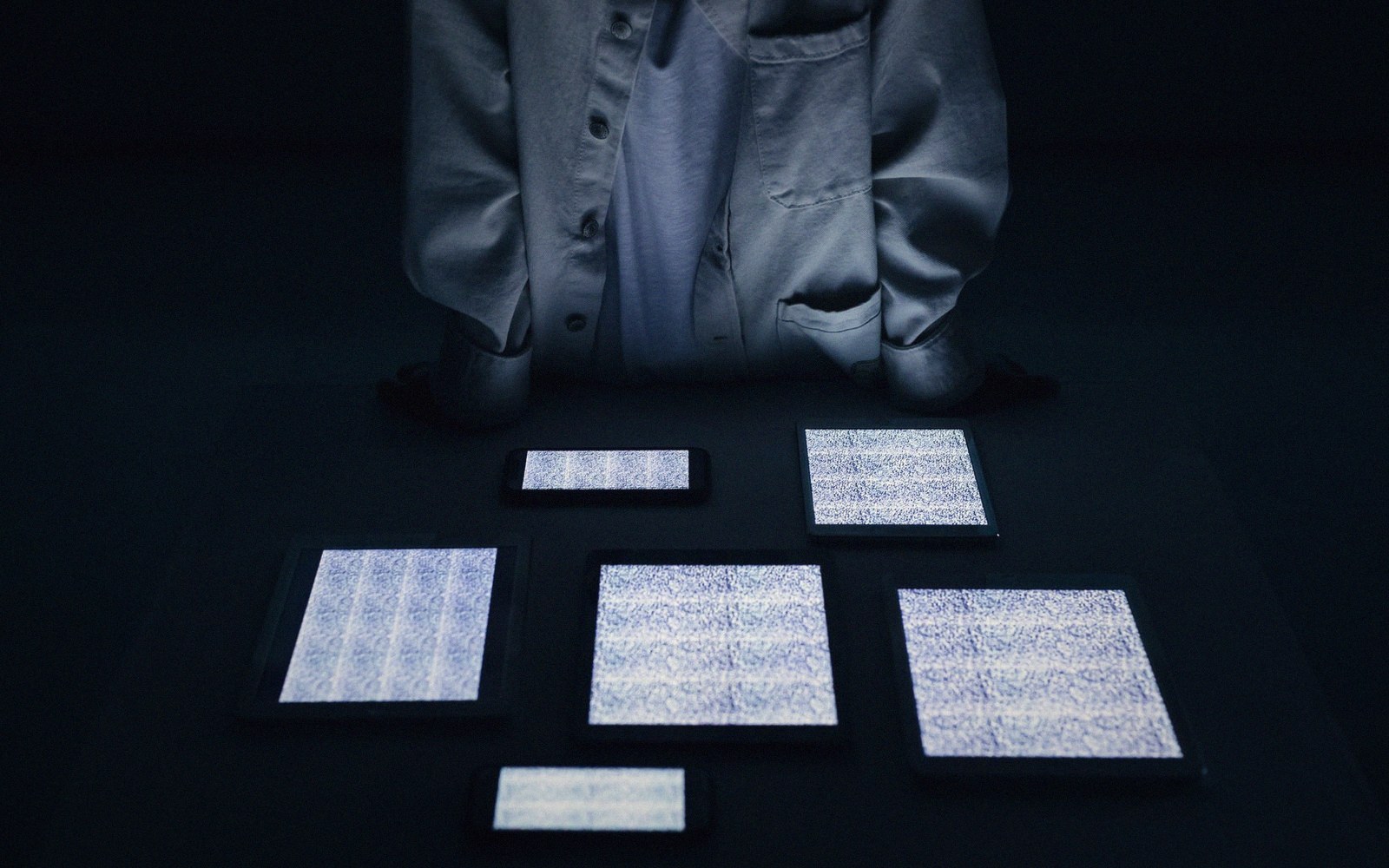
Black Level
Fig. 01 · What the panel does with a frame that asks for nothing at all. · Photo: Ron Lach / Pexels
What the panel does when it is asked to show nothing.
- The trade-off
- A deeper floor usually costs peak output, uniformity, or money.
- Which way to spend
- Spend on the floor before the ceiling.
What happens when the panel shows nothing
The ideal black is the absence of light. In practice, every display technology fails this ideal to some degree, and the manner of that failure determines how much of the picture you can actually see.
When a panel is asked to render a pixel at code value zero — pure black in the signal — it has to either stop emitting light entirely or block it completely.
Whether it can do either depends on how the technology works at a physical level. An emissive display where each pixel generates its own light can, in principle, simply switch off.
A transmissive panel has a backlight running continuously behind it, and a liquid-crystal shutter in front of each pixel trying to prevent that light from escaping. "Trying" is the operative word: the shutter never closes perfectly, and some light leaks through. That residual glow is the black level — the floor the image sits on.
The number matters because contrast ratio is defined as the luminance of peak white divided by the luminance of black. If your black is not truly dark, the ratio collapses regardless of how bright the white peak is.
A panel with a slightly elevated black floor but blazing highlights will still show shallow, washed-out shadows, because the shadow detail is riding on that floor, not sitting below it.

2
A grey-scale run read off the panel rather than off the menu.
Photo: Tima Miroshnichenko / Pexels
Why the floor is hard to lower
Liquid-crystal panels leak light in two ways. The polarisers that sandwich the liquid-crystal layer are not perfect — some light slips through even when the crystals are fully aligned to block it.
And the backlight itself scatters slightly before it reaches the shutter layer. Local dimming addresses the second problem by dimming or extinguishing zones of the backlight behind dark areas of the image, but it is a coarse approximation, and the halo artifacts it produces are visible precisely because the zone boundaries do not align with pixel boundaries.
Emissive technologies — OLED, micro-LED at full per-pixel resolution — sidestep the polariser leakage entirely, because there is no backlight to manage. Each pixel is its own light source and can be turned off independently.
This gives an absolute black that transmissive panels cannot match at the pixel level. The caveat is that adjacent lit pixels produce a faint optical scatter, so the measured black level in a real image with mixed content is marginally higher than the absolute zero you measure in a fully black frame. It is still dramatically lower than most transmissive panels can achieve.
Plasma, now out of production, occupied a similar position to OLED: emissive, per-pixel, deep blacks — but with a minimum sustain voltage that prevented cells from reaching true zero, giving a dark grey rather than absolute black, measurably deeper than LCD yet not quite absolute zero.
Lifted out of the flow — Contrast
Key relationships
The room raises the floor independently
Here is the thing most panel specifications do not tell you: the black level of the panel is only one contributor to perceived black in the room. Any ambient light — even a few lux from a standby LED or a gap under a door — reflects off the screen surface and raises the apparent black level regardless of what the panel is doing.
A screen surface with gain reflects more directional light efficiently but also concentrates any ambient source falling on it. A matte surface diffuses ambient light more uniformly but raises the overall floor more evenly.
Neither surface can make a lit room's blacks competitive with what the same panel achieves in darkness, which is why the room itself is always raising the black before the panel even begins.
This is why the engineering priority for a dedicated cinema room is not to buy the panel with the lowest specified black level, but first to control the room.
Once ambient light is genuinely low, the panel's native black floor becomes the dominant variable — and at that point, the difference between technologies becomes both measurable and visible. Get the room right first, and the panel's floor matters. Leave the room lit and the panel's spec is largely theoretical.
The last part of the chain worth worrying about, and the first part most people change.
Photo: Anthony 🙂 / Pexels
This gives an absolute black that transmissive panels cannot match at the pixel level.