
Emissive and transmissive
Fig. 01 · Whether a pixel makes its own light or filters a backlight decides most of what follows. · Photo: Rafael Minguet Delgado / Pexels
The distinction between a pixel that makes light and one that merely passes it shapes every engineering trade-off that follows.
- The trade-off
- Per-pixel black against sustained full-field brightness.
- Which way to spend
- Spend on the technology that suits the light you actually have.
What the backlight costs you
A liquid-crystal panel is fundamentally a shutter. The backlight — a bank of LEDs arranged behind the glass — runs continuously, and the liquid-crystal layer in front of it rotates to either block or pass that light on a per-pixel basis.
The consequence is inescapable: blocking is never perfect. Some light leaks through even when the pixel is instructed to be black, and that residual glow sets a floor on how dark the panel can get.
Everything built on that floor — shadow detail, the apparent punch of highlights, the subjective sense of depth — is limited by a physical property of the material, not by the quality of the image processor or the brightness of the backlight. More backlight buys more peak brightness but also more leak; the ratio does not improve simply by turning things up.
Local dimming is the engineering response to this. Divide the backlight into independently controlled zones and dim the zones behind dark parts of the image.
The black floor drops in those regions, and the panel's native contrast ratio — the figure measured with the backlight optimised — climbs toward something usable.
But zones are not pixels. A bright object surrounded by dark sky forces the zone behind it to stay lit, and the light spills into the neighbouring dark zones as a visible halo. Smaller zones reduce the artifact; per-pixel control would eliminate it entirely. That is precisely what an emissive panel delivers.
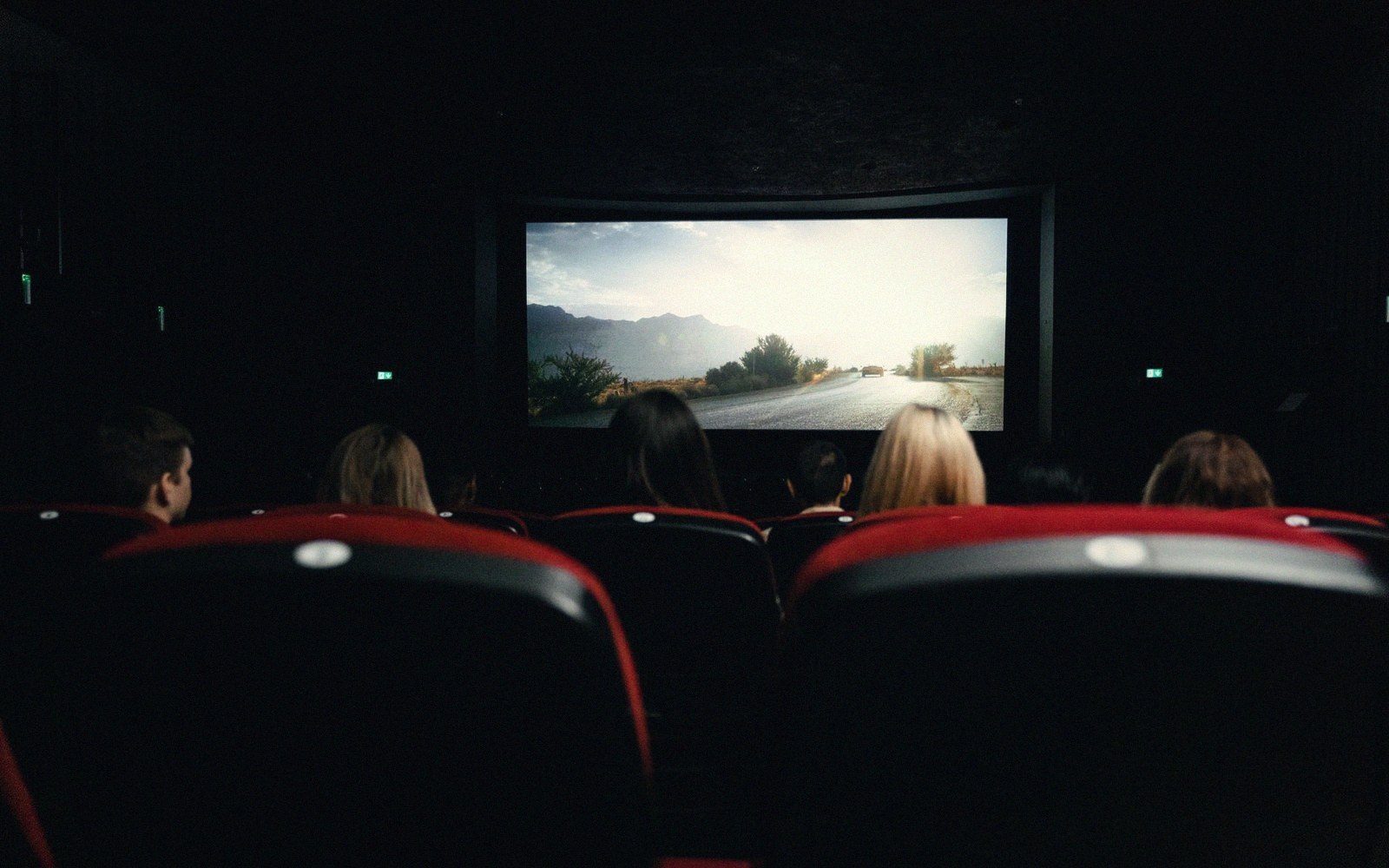
2
The only light in the room is the one being measured.
Photo: Tima Miroshnichenko / Pexels
When the pixel is the source
In an emissive display, each sub-pixel generates its own light directly. OLED uses an organic compound that electroluminesces — emits light when current passes through it. MicroLED uses inorganic semiconductor structures, each one a microscopic LED.
In both cases, a pixel commanded to black simply stops emitting. The black level is not the residual leak of a blocked shutter; it is the absence of any emission at all.
In a properly dark room, against a correctly calibrated black signal, an emissive pixel produces no measurable light. The contrast ratio between a white pixel and its immediate neighbour showing black is, in any practical sense, infinite — which is why black level discussions for these panels quickly shift from the panel itself to the room, because the room's reflected light becomes the binding constraint.
That absolute black also means the panel draws almost no power in dark scenes. A transmissive panel keeps its backlight running regardless.
The energy saving in an emissive panel scales with average picture level — a predominantly dark film draws dramatically less than a bright nature documentary — whereas an LCD's power consumption is roughly constant because the backlight is always on.
The trade-off runs in the other direction at high brightness. A transmissive panel can push the backlight harder without limit other than heat. An OLED sub-pixel is an organic compound, and sustained high current accelerates its degradation; the panel's control system therefore constrains peak brightness, particularly over large areas, to protect longevity.
The organic compounds also age at slightly different rates for each colour, which is the mechanism behind the burn-in concern — though real-world impact at normal use patterns is far smaller than the headline implies.
MicroLED avoids both problems by using inorganic semiconductors, which are far more stable and tolerate higher current, but the manufacturing challenge of placing tens of millions of microscopic LEDs with sufficient yield has kept the technology expensive and large-format.
Lifted out of the flow — Panels
The core trade-off in numbers
The choice is upstream of everything else
Understanding the emissive versus transmissive split matters because it determines which calibration targets are achievable, where the room's behaviour matters most, and what your acoustic and lighting choices actually need to compensate for.
A transmissive panel in a room with any ambient light is fighting on two fronts: the backlight leak raising the black floor from inside, and the reflected room light raising it from outside.
An emissive panel in the same room has already won half that battle — but only half, because the room is still bouncing the bright parts of the image back onto the screen, lifting the black from the outside just the same. Neither technology exempts you from controlling the room. They just determine which problem is structural and which is environmental.
Absorption goes where the mirror shows a driver, not where there is a convenient gap.
Photo: Guillaume Meurice / Pexels
The black level is not the residual leak of a blocked shutter; it is the absence of any emission at all.
Lifted out of the flow — Panels