More Than One Subwoofer
Fig. 01 · Two patterns of cancellation that do not overlap beat one that does. · Photo: Francesco Ungaro / Pexels
Two subs placed deliberately will outperform one sub placed perfectly — and the reason is the room, not the drivers.
- The trade-off
- Two modest sources against one large one.
- Which way to spend
- Spend on a second source rather than a bigger one.
Why Two Win
A single subwoofer excites the room's resonant modes from one point. The standing waves that result create a map of peaks and nulls that is fixed in space — move a metre from the sweet spot and the bass changes completely, not because the sub is inadequate but because the room is doing what rooms do.
You cannot EQ your way out of this. Parametric correction can flatten a peak at one position while making the null somewhere else worse; it is sculpting one point in a three-dimensional field.
Add a second subwoofer at a different position and something genuinely useful happens: the two sources drive the modes differently, and their combined excitation pattern becomes more even across the room.
The peaks and nulls do not cancel perfectly — this is not magic — but the variance between seats drops substantially. In a typical rectangular room, a subwoofer placed opposite the first (front wall to back wall, or diagonally opposing corners) produces the greatest spatial averaging because the two sources are as different from each other as the room allows. Same output, same frequency range, radically more even distribution.
The second benefit is headroom. Two subs each working at moderate excursion produce less port noise, less distortion, and less thermal compression than one driver pushed hard.
Bass distortion is rarely heard as grit — it is felt as a vague, effortful quality that listeners attribute to the program material rather than the transducer. Two subs running relaxed simply sound cleaner.
2
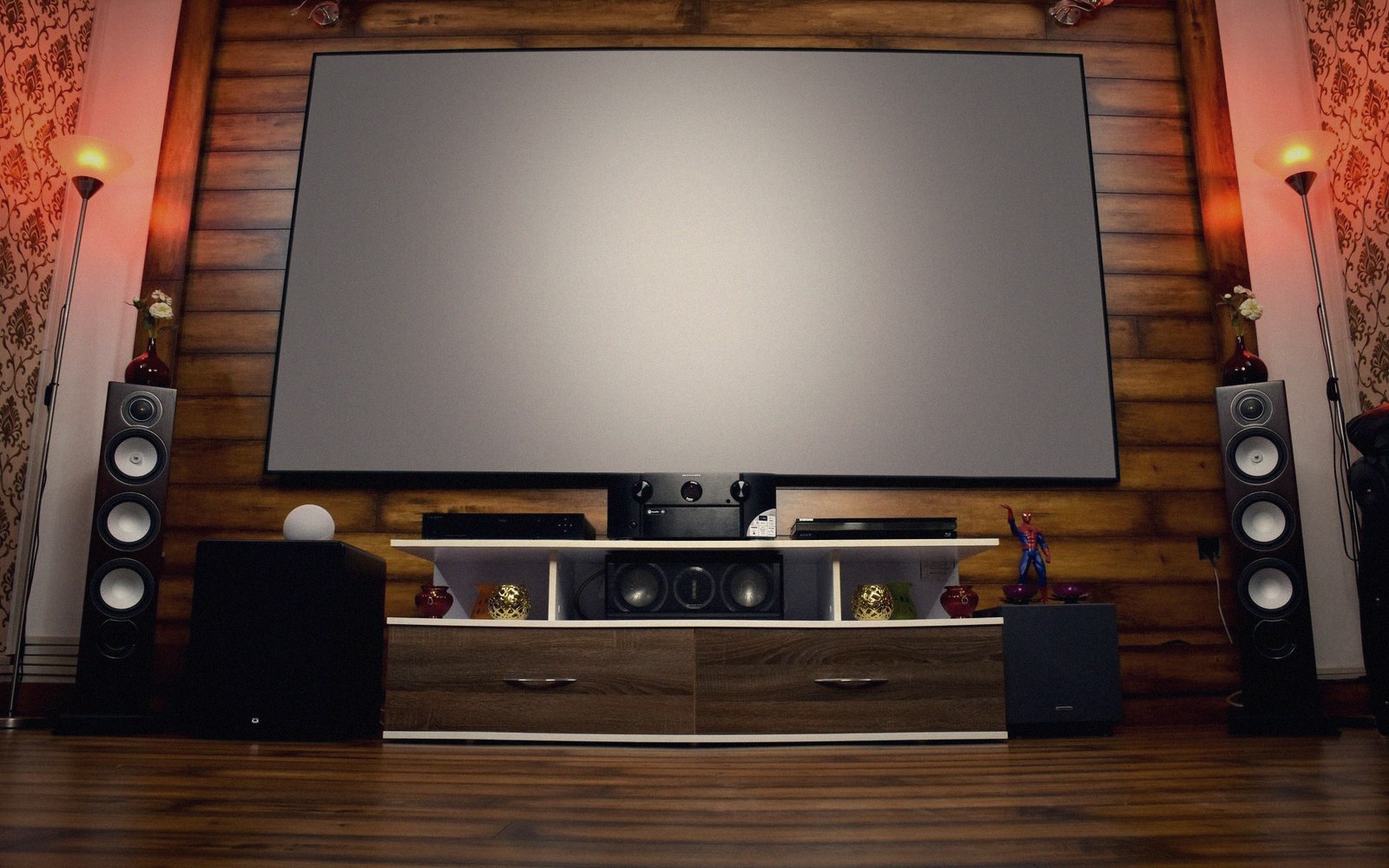
A corner loads the room hardest — useful for level, unhelpful for evenness.
Photo: Avinash Kumar / Pexels
Placement logic follows the averaging goal, not aesthetics. Symmetrical along the front wall helps centre-channel integration but does little for modal distribution. An asymmetric placement — one front, one side or rear — sacrifices some stereo symmetry but serves the whole room.
In a cinema-layout room where everybody has a seat rather than just the owner, the asymmetric pair is almost always the better engineering choice.
Lifted out of the flow — Bass
The core geometry
Two patterns of cancellation that do not overlap beat one that does.
Photo: Jan van der Wolf / Pexels
Symmetrical along the front wall helps centre-channel integration but does little for modal distribution.